
Use of shall be and will be in Hindi – Rules, Examples and Exercises. Meaning of Shall be and Will be with definition and use in Hindi. Shall be तथा Will be का प्रयोग हिंदी में।
Shall be तथा Will be का प्रयोग Future Tense के वाक्यों में Helping Verb तथा Modal Auxiliary के रूप में करते हैं। जैसे:
Examples:
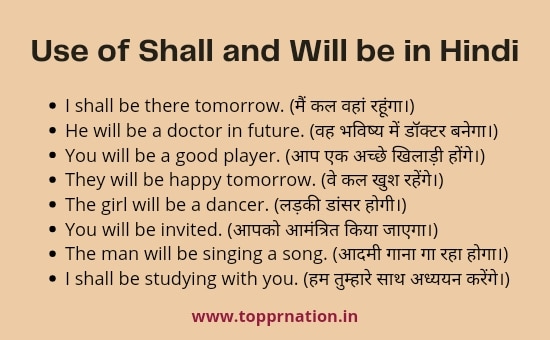
- I shall be there tomorrow. (मैं कल वहां रहूंगा।)
- He will be a doctor in future. (वह भविष्य में डॉक्टर बनेगा।)
- You will be a good player. (आप एक अच्छे खिलाड़ी होंगे।)
- They will be happy tomorrow. (वे कल खुश रहेंगे।)
- The girl will be a dancer. (लड़की डांसर होगी।)
- You will be invited. (आपको आमंत्रित किया जाएगा।)
- The man will be singing a song. (आदमी गाना गा रहा होगा।)
- I shall be studying with you. (हम तुम्हारे साथ अध्ययन करेंगे।)
Note: ऊपर दिए गए वाक्यों में shall be तथा will be का प्रयोग helping verb की तरह हुआ है। वाक्य संख्या 7 व 8 में Future Continuous Tense का प्रयोग हुआ है।
इस पोस्ट के माध्यम से आप shall be तथा will be के rules, examples and exercises को आप हिंदी में पढ़ेंगे।
Use of Shall Be and Will Be in Hindi
Shall be तथा Will be का प्रयोग वाक्यों के साथ करते हैं जिनके अंत में रहेगा, रहेगी, रहेंगे या बनेगा, बनेगी, बनेंगे, होगा, होगी, होंगे आदि शब्द आते हैं। Shall be तथा Will be के प्रयोग से पता चलता है कि भविष्य में किसी वस्तु या व्यक्ति की स्थिति स्थाई रूप से कायम रहेगी। जैसे;
1. आपका बेटा एक डॉक्टर बनेगा।
Your son will become a doctor.
2. तुम्हारी गाय स्वस्थ होगी।
Your cow will be healthy.
3. यह लड़की भूखी बनी रहेगी।
This girl will remain hungry.
4. सोनू स्वस्थ रहेगा।
Sonu will be healthy.
5. वह कल दिल्ली में होगा।
He will be in Delhi tomorrow.
6. शिवम अपने दादाजी के साथ होगा।
Shivam will be with his grandfather.
7. वह खुश रहेगी।
She will be happy.
8. वे अब वे दुखी नहीं होंगे।
They will not be unhappy now.
9. किसान अपने खेतों में होंगे।
Farmers will be in their fields.
10. वह कानपुर में होगा।
He will be in Kanpur.
Meaning of Shall Be and Will be in Hindi
Shall be तथा Will be का Hindi में अर्थ होगा, होगी, होंगे, रहेगा, रहेगी, रहेंगे, बनेगा, बनेगी, बनेंगे आदि होता है। इसका प्रयोग भविष्य मैं किसी व्यक्ति की दशा या स्थिति को व्यक्त करने के लिए करते हैं।
How to use Shall be and Will be
वाक्यों में shall be तथा will be का प्रयोग हेल्पिंग वर्ब तथा मॉडल ऑफ जरी वर्क की तरह होता है। Shall be तथा Will be का प्रयोग करते समय लोगों में यह कन्फ्यूजन रहता है कि यह मॉडल ऑग्ज़ीलियरी वर्ब है या हेल्पिंग वर्ब है। जैसा कि आप जानते हैं कि shall तथा will auxiliary verbs हैं इनके साथ verb – be जोड़ कर मुख्य क्रिया के रूप में प्रयोग किया जाता है। नीचे दिए गए नियमों को ध्यान से पढ़ें;
Rules:
Shall be का प्रयोग First Person Pronoun ‘I तथा We’ के साथ करते हैं।
- I shall be ………
- We shall be ………
Will be का प्रयोग Second Person तथा Third Person Pronoun के साथ करते हैं।
- You will be
- He will be
- It will be
- Raju will be
- There will be
- They will be
- The girl will be
- The boys will be
Read Also:
Affirmative Sentences
Shall be तथा Will be का प्रयोग साधारण वाक्य में निम्न प्रकार से करते हैं।
- सर्वप्रथम वाक्य का कर्ता (subject) लिखते हैं।
- उसके बाद हेल्पिंग वर्ब के रूप में shall be या will be लिखते हैं।
- इसके बाद कोई संज्ञा या विशेषण या अन्य शब्दों को लिखा जाता है।
- वाक्य के अंत में full stop (.) लगाते हैं।
Structure: Subject+ shall be/will be + noun/adjective +other words
Examples:
1. कल वह व्यस्त बना रहेगा।
Tomorrow he will be busy.
2. वह कानपुर में होगा।
He will be in Kanpur.
3. तुम्हारा पुराना मित्र मैदान में होगा।
Your old friend will be in the field.
4. उसका घर कानपुर में होगा।
His house will be in Kanpur.
5. यह खिलाड़ी थके होंगे।
These players will be tired.
6. सोहन एक अच्छा डॉक्टर बनेगा।
Sohan will be a good doctor.
7. वह कल यहां होगा।
He will be here tomorrow.
8. सोहन 2:00 बजे पार्क में होगा।
Sohan will be in the park at 2:00.
9. बच्चे नए कपड़ों में होंगे।
Children will be in new clothes.
10. कल बहुत सर्दी होगी।
Tomorrow will be very cold.
11. आज कम गर्मी होगी।
It will be less hot today.
12. श्यामलाल एक ईमानदार व्यक्ति होगा।
Shyamlal will be an honest person.
13. रेखा दो जनवरी को 20 वर्ष की होगी।
Rekha will turn 20 on January 2.
14. हमारा नया मित्र दिल्ली में होगा।
Our new friend will be in Delhi.
15. वह कल स्टेशन पर होगा।
He will be at the station tomorrow.
Read also:
Negative Sentences
Structure: Subject + will be/shall be + noun/adjective + other words
Examples:
1. यह गाड़ी नीली नहीं होगी।
This car will not be blue..
2. शेर जंगल में नहीं होगा।
The lion will not be in the forest.
3. यह लड़का ड्राइवर नहीं बनेगा।
This boy will not become a driver.
4. मिस्टर वर्मा एक प्रोफेशन नहीं होंगे।
Mr. Verma will not be a profession.
5. तुम नाराज नहीं होगे।
You will not be angry.
6. वह कल खुश नहीं होगा।
He will not be happy tomorrow.
7. सोहन पार्क में नहीं होगा।
Sohan will not be in the park.
8. यह मॉल कल बंद नहीं होगा।
This mall will not be closed tomorrow.
9. मछलियां ताजी नहीं होगी।
The fish will not be fresh.
10. ये हरे आम मीठे नहीं होंगे।
These green mangoes will not be sweet.
11. रोहन अपने पिता जी के साथ नहीं होगा।
Rohan will not be with his father.
12. वह व्यस्त नहीं होगा।
He won’t be busy.
13. तुम कल मेरे साथ नहीं होगे।
You will not be with me tomorrow.
14. मैं 2:00 बजे घर पर नहीं हूंगा।
I will not be at home at 2:00.
15. वह बगीचे में नहीं होगा।
He will not be in the garden.
Read also:
- Future Indefinite Tense
- Future Continuous Tense
- Future Perfect Tense
- Future Perfect Continuous tense
Interrogative Sentences
‘क्या’ से शुरू होने वाले या किसी वाक्य के बीच में प्रश्नवाचक शब्द आता है, तो वे वाक्य Interrogative कहलाते हैं। इन वाक्यों में shall be तथा will be का प्रयोग निम्न प्रकार से करते हैं;
Yes-No Type Questions
यदि कोई वाक्य क्या से शुरू है तो वह वाक्य yes-no type question कह लाता है। ऐसे वाक्यों में ‘क्या’ की अंग्रेजी नहीं लगाते हैं। उसके स्थान पर सहायक क्रिया को पहले रखते हैं।
- सबसे पहले ‘क्या’ की अंग्रेजी की जगह shall या will रखते हैं।
- उसके बाद subject को रखते हैं।
- Subject के बाद be जोड़ते हैं।
- उसके बाद संज्ञा (noun) या विशेषण (adjective) रखते हैं।
- उसके बाद आने शब्दों को लिखते हैं तथा अंत में प्रश्नवाचक चिन्ह लगाते हैं।
Structure: Shall/Will + subject + be + noun/adjective + other words +?
Examples:
1. क्या राजू एक गायक होगा?
Will Raju be a singer?
2. क्या तुम ईमानदार बनोगे?
Will you be honest?
3. क्या चौहान अपने गांव में होगा?
Will Chauhan be in his village?
4. क्या राधा एक डॉक्टर होगी?
Will Radha be a doctor?
5. क्या यह लोग खुश होंगे?
Will these people be happy?
6. क्या आप के छात्र होशियार होंगे?
Will your students be smart?
7. क्या राजू इस समय घर पर होगा?
Will Raju be at home this time?
8. क्या तुम कल उपस्थित होंगे?
Will you be present tomorrow?
9. क्या राधा नाराज होगी?
Will Radha be angry?
10. क्या तुम कानपुर में मेरे साथ होगे?
Will you be with me in Kanpur?
11. क्या वह इलाहाबाद में होगा?
Will he be in Allahabad?
12. क्या बच्चे शरारती होगे?
Will the children be naughty?
13. क्या तुम एक इंजीनियर बनोगे?
Will you be an engineer?
14. क्या सोहन एक अच्छा व्यक्ति होगा?
Will Sohan be a good person?
15. क्या वे कल आपके साथ होंगे?
Will they be with you tomorrow?
Wh-word Type Questions
जिन वाक्यों के बीच में कोई प्रश्नवाचक शब्द आता है उनको हिंदी से अंग्रेजी में ट्रांसलेट करने के लिए नीचे दिए गए सेंटेंस स्ट्रक्चर का प्रयोग करते हैं।
हिंदी वाक्यों के बीच में आए हुए प्रश्नवाचक शब्द (question word) की अंग्रेजी को वाक्य के प्रारंभ में रखते हैं तथा नीचे दिए गए सेंटेंस स्ट्रक्चर को फॉलो करते हैं।
Structure: Question word + Shall/Will + subject + be + noun/adjective + other words +?
Examples:
1. सोहन 2:00 बजे कहां होगा?
Where will it be at 2:00 pm?
2. तुम भविष्य में क्या बनोगे?
What will you be in the future?
3. वह जनवरी में कहां होगा?
Where will he be in January?
4. दरवाजे पर कौन होगा?
Who will be at the door?
5. श्याम कल उदास क्यों होगा?
Why will Shyam be sad tomorrow?
6. आपके पुत्र को खुश क्यों होंगे?
Why will your son be happy?
7. मैं अमेरिका में कब हूंगा?
When will I be in the US?
8. रोहन एक पायलट कब बनेगा?
When will Rohan become a pilot?
9. तुम मेरे साथ कानपुर में कब होगी?
When will you be with me in Kanpur?
10. वह अपनी दुकान क्यों होगा?
Why would he have his own shop?
Use of Shall be and will be
(1) Shall be तथा Will be का प्रयोग भविष्य में किसी वस्तु या व्यक्ति की स्थिति या दशा को व्यक्त करने के लिए करते हैं। उस व्यक्ति या वस्तु की यह स्थिति भविष्य में कायम रहती है। जैसे;
1. सोहन एक इंजीनियर बनेगा।
Sohan will become an engineer.
2. मैं आपके साथ होउंगा।
I will be with you.
3. तुम अपने जन्मदिन पर खुश होगे।
You will be happy on your birthday.
4. वे भी छत पर नहीं होंगे।
They will not be on the roof.
5. कमरे में दो बिल्लियां होंगी।
There will be two cats in the room.
Note: ऊपर दिए गए सभी वाक्य Future Indefinite Tense के हैं क्योंकि इनके साथ हेल्पिंग वर्ब shall तथा will के साथ मुख्य क्रिया be का प्रयोग किया गया है।
(2) Future Continuous Tense में shall be तथा will be का प्रयोग helping verb के रूप में होता है। इसके साथ मुख्य क्रिया में ing जोड़ते हैं।
1. वह कल कानपुर जा रहा होगा।
He will be going to Kanpur tomorrow.
2. तुम यह कहानी पढ़ रहे होगे।
You will be reading this story.
3. हम शाम को मैच खेल रहे होंगे।
We will be playing a match in the evening.
4. वह कहानी नहीं पढ़ रहा होगा।
He will not be reading the story
5. He लोगों की सेवा नहीं कर रहा होगा।
The king will not be serving the people.
6. तुम उसे पैसे दे रहे होगे।
You will be giving him money.
7. क्या मैं यह घड़ी खरीद रहूंगा?
Will I be buying this watch?
8. क्या वह कानपुर जाता रहेगा?
Will he continue to go to Kanpur?
9. तुम उसे कब चलाने दे रहे होगे?
When will you be letting him drive?
10. तुम अपने दोस्तों के साथ क्या कर रहे होगे?
What will you be doing with your friends?
Shall be and Will be Exercises in Hindi
Translate the following sentences into English
1. सोहन 2015 में डॉक्टर होगा।
2. राजेश अपने गांव में होगा।
3. माली बगीचे में होगा।
4. चपरासी दरवाजे पर होगा।
5. चौकीदार यहां नहीं होगा।
6. क्या तुम्हारा कुत्ता खूंखार होगा?
7. क्या यह घड़ी अच्छी होगी?
8. क्या वे अपने शहर में होंगे?
9. क्या तुम नाराज नहीं होगे?
10. क्या वह चालाक नहीं होगा?
11. आप खुश क्यों नहीं होगे?
13. वह कल दुखी क्यों होगा?
14. राजा कहानी सुन रहा होगा।
15. बच्चे कमरे में खेल रहे होंगे।
16. राजेश पत्र लिख रहा होगा।
17. आपका भाई कहानी पढ़ रहा होगा।
18. क्या सोहन गाना गा रहा होगा?
19. क्या तुम कहानी लिख रहे होगे?
20. क्या राजेश आपकी मदद कर रहा होगा?
Answers of Exercise
1. Sohan will be a doctor in 2015.
2. Rajesh will be in his village.
3. The gardener will be in the garden.
4. The peon will be at the door.
5. The watchman will not be here.
6. Will your dog be dreadful?
7. Will this watch be cool?
8. Will they be in their city?
9. Won’t you be angry?
10. Wouldn’t that be clever?
11. Why won’t you be happy?
13. Why will he be sad tomorrow?
14. The king will be listening to the story.
15. Children will be playing in the room.
16. Rajesh will be writing the letter.
17. Your brother will be reading the story.
18. Will Sohan be singing a song?
19. Will you be writing the story?
20. Will Rajesh be helping you?
Read also:
- Present Indefinite Tense in Hindi
- Present Perfect Tense in Hindi
- Present Perfect Continuous Tense in Hindi
- Past Indefinite Tense in Hindi
- Past Continuous Tense in Hindi
- Past Perfect Tense in Hindi
- Past Perfect Continuous Tense in Hindi

- Class 4 Hindi to English Translation (Sentences) - December 17, 2025
- 100 Sentences of Simple Future Tense in Hindi - June 6, 2024
- Present Tense in Hindi – परिभाषा, प्रकार तथा उदाहरण - March 17, 2024
Will be shall be kaa sentence
Hare Krishna. Bahut accha hain, samajh mein aasani se aaya.