
Pronouns Examples in Hindi are very useful for the students or learners who are learning or practising Parts of Speech through Hindi. A pronoun is a very important part of a sentence when we don’t want to repeat a noun or nouns in a paragraph. Every English learner must learn about the pronouns carefully and use them.
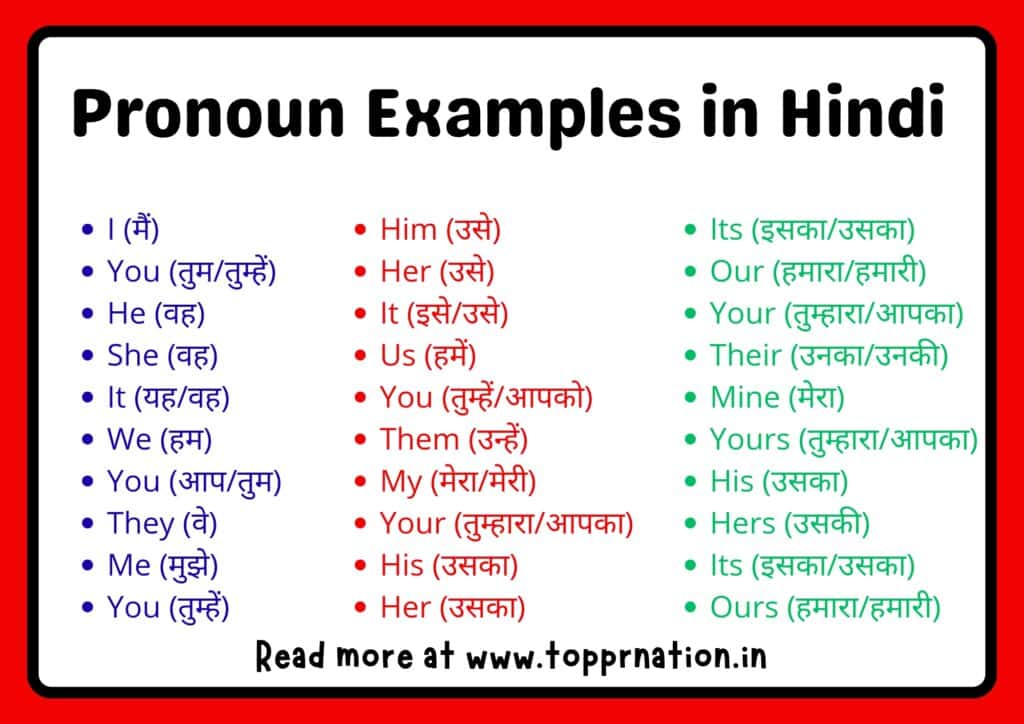
इस पोस्ट में Pronoun examples (उदाहरण) Hindi व English में दिए गए हैं। इन examples को पढ़ने के बाद pronouns के वाक्यों को अच्छी तरह समझ पाएंगे।
Pronoun Examples in Hindi (सर्वनाम के उदाहरण हिंदी में अर्थ सहित)
Pronoun (प्रोनाउन) को हिंदी में सर्वनाम कहते हैं। English Grammar में Parts of Speech में Pronouns वे शब्द होते हैं जो किसी संज्ञा के स्थान पर प्रयोग किए जाते हैं। जैसे:
1. राम एक अच्छा लड़का है। वह प्रतिदिन विद्यालय जाता है। (Ram is a good boy. He goes to school daily.)
2. बकरियां मैदान में हरी घास खा रही हैं। वे भूखी हैं। (The goats are eating the green grass in the field. They are hungry.)
3. मेरी कुर्सी पुरानी है। यह लकड़ी की बनी हुई है। (My chair is old. It is made of wood.)
4. मीरा 10 साल की है। वह कक्षा चार में पढ़ती है।(Meera is 10 years old. She studies in class 4.)
5. राजू और रोहन अमेरिका में रहते हैं। वे एक होटल में काम करते हैं। (Raju and Rohan live in America. They work in a hotel.)
Note: ऊपर दिए गए Pronoun के Hindi व English Examples नीले रंग में लिखे हुए शब्द संज्ञा हैं तथा लाल रंग में लिखे हुए शब्द सर्वनाम के उदाहरण हैं।
List of Pronouns in Hindi
1. I (मैं)
2. You (तुम/तुम्हें)
3. He (वह)
4. She (वह)
5. It (यह/वह)
6. We (हम)
7. You (आप/तुम)
8. They (वे)
9. Me (मुझे)
10. You (तुम्हें)
11. Him (उसे)
12. Her (उसे)
13. It (इसे/उसे)
14. Us (हमें)
15. You (तुम्हें/आपको)
16. Them (उन्हें)
17. My (मेरा/मेरी)
18. Your (तुम्हारा/तुम्हारी/आपका/आपकी)
19. His (उसका)
20. Her (उसका)
21. Its (इसका/उसका)
22. Our (हमारा/हमारी)
23. Your (तुम्हारा/तुम्हारी/आपका/आपकी)
24. Their (उनका/उनकी)
25. Mine (मेरा)
26. Yours (तुम्हारा/तुम्हारी/आपका/आपकी)
27. His (उसका)
28. Hers (उसकी)
29. Its (इसका/उसका)
30. Ours (हमारा/हमारी)
31. Yours (तुम्हारा/तुम्हारी/आपका/आपकी)
32. Theirs (उनका/उनकी)
33. Myself (खुद/मैं)
34. Yourself (खुद/तुम)
35. Himself (खुद/वह)
36. Herself (खुद/वह)
37. Itself (खुद/यह/वह)
38. Ourselves (खुद/हम)
39. Yourselves (खुद/तुम)
40. Themselves (खुद/वे)
41. This (यह)
42. That (वह)
43. These (ये)
44. Those (वे)
45. Such (ऐसा)
46. This one (यह एक)
47. That one (वह एक)
48. These ones (ये)
49. Those ones (वे)
50. All (सभी)
51. Some (कुछ)
52. None (कोई नहीं)
53. Any (कोई भी)
54. Every (हर)
55. Many (कई)
56. Few (कुछ)
57. Several (कई)
58. One (एक)
59. Two (दो)
60. Three (तीन)
61. Both (दोनों)
62. Either (दोनों में से कोई एक)
63. Neither (न तो एक न दूसरा)
64. Some (कुछ)
65. Any (कोई भी)
66. All (सभी)
67. None (कोई नहीं)
68. Each (प्रत्येक)
69. Every (हर)
70. Other (अन्य)
71. Another (और एक)
72. Several (कई)
73. None (कोई नहीं)
74. Much (बहुत)
75. Many (कई)
76. A few (कुछ)
77. Several (कई)
78. All (सभी)
79. Some (कुछ)
80. Both (दोनों)
81. Either (दोनों में से कोई एक)
82. Neither (न तो एक न दूसरा)
83. All (सभी)
84. Some (कुछ)
85. Many (कई)
86. Few (कुछ)
87. Several (कई)
88. One (एक)
89. Both (दोनों)
90. Either (दोनों में से कोई एक)
91. Neither (न तो एक न दूसरा)
92. Each (प्रत्येक)
93. Every (हर)
94. Some (कुछ)
95. Any (कोई भी)
96. All (सभी)
97. None (कोई नहीं)
98. Several (कई)
99. Few (कुछ)
100. Many (कई)
Read also:
- Adjective (विशेषण)
- Verb (क्रिया)
- Adverb (क्रिया विशेषण)
- Preposition (संबंध सूचक)
- Conjunction (संयोजक)
- Personal Pronouns (व्यक्तिगत सर्वनाम)
Pronoun Sentences in Hindi
1. I – I am a teacher. (मैं एक शिक्षक हूँ।)
2. You – You are my friend. (तुम मेरे मित्र हो।)
3. He – He plays cricket with his friends. (वह अपने मित्रों के साथ क्रिकेट खेलता है।)
4. She – She sings well. (वह अच्छा गाती है।)
5. It – It is raining outside. (बाहर बारिश हो रही है।)
6. We – We are ready. (हम तैयार हैं।)
7. You – You should listen to your father carefully. (आपको अपने पिता की बात को ध्यान से सुनना चाहिए।)
8. They – They are students of that school. (वे उस विद्यालय के छात्र हैं।)
9. Me – Please help me. (कृपया मेरी मदद करो।)
10. You – I wrote a letter to you. (मैंने तुम्हें एक पत्र लिखा।)
11. Him – I beat him yesterday. (मैं उसकी कल पिटायी की।)
12. Her – She invited her. (उसने उसे आमंत्रित किया।)
13. It – Give it to me. (इसे मुझे दो।)
14. Us – He invited us. (उसने हमें आमंत्रित किया।)
15. You – I will meet you at 10 o’clock tomorrow. (मैं आपको कल 10:00 बजे मिलूंगा।)
16. Them – I saw them outside. (मैंने उन्हें बाहर देखा।)
17. My – This is my favourite book. (यह मेरी प्रिय किताब है।)
18. Your – Your shirt is green. (तुम्हारी कमीज हरी है।)
19. His – His car is old. (उसकी कार पुरानी है।)
20. Her – Her dress is not new. (उसकी पोशाक नयी नहीं है।)
21. Its – The dog wagged its tail. (कुत्ते ने अपनी पूँछ हिलाई।)
22. Our – Our Village is big. (हमारा गांव बड़ा है।)
23. Your – Your work is good. (आपका कार्य अच्छा है।)
24. Their – Their house is in Delhi. (उनका घर दिल्ली में है।)
25. Mine – This kite is mine. (यह पतंग मेरी है।)
26. Yours – This bike is yours. (यह बाइक आपकी है।)
27. His – That room is his. (वह कक्ष उसका है।)
28. Hers – The table is hers. (मेज उसकी है।)
29. Its – This cage is its. (यह पिंजरा इसका है।)
30. Ours – The factory is ours. (फैक्ट्री हमारी है।)
31. Yours – The fault is yours. (गलती तुम्हारी है।)
32. Theirs – The responsibility is theirs. (जिम्मेदारी उनकी है।)
33. Myself – I did it myself. (मैंने यह खुद किया।)
34. Yourself – Do it yourself. (इसे खुद करो।)
35. Himself – He hurt himself. (उसने खुद को चोट पहुँचाई।)
36. Herself – She cooked herself. (उसने खुद खाना बनाया।)
37. Itself – The door closed itself. (दरवाजा अपने आप बंद हो गया।)
38. Ourselves – We enjoyed ourselves. (हमने खूब आनंद लिया।)
39. Yourselves – You should help yourselves. (तुम लोगों को खुद मदद करनी चाहिए।)
40. Themselves – They prepared themselves. (उन्होंने खुद को तैयार किया।)
41. This – This is my house. (यह मेरा घर है।)
42. That – That is a temple. (वह एक मंदिर है।)
43. These – These are my books. (ये मेरी किताबें हैं।)
44. Those – Those are cows. (वे गायें हैं।)
45. Such – Such people are rare. (ऐसे लोग दुर्लभ होते हैं।)
46. This one – This one is easy. (यह वाला आसान है।)
47. That one – That one is difficult. (वह वाला कठिन है।)
48. These ones – These ones are new. (ये वाले नए हैं।)
49. Those ones – Those ones are old. (वे वाले पुराने हैं।)
50. All – All students passed. (सभी छात्र पास हो गए।)
51. Some – Some boys are absent. (कुछ लड़के अनुपस्थित हैं।)
52. None – None was present. (कोई भी उपस्थित नहीं था।)
53. Any – Is there any water? (क्या कोई पानी है?)
54. Every – Every child needs love. (हर बच्चे को प्यार चाहिए।)
55. Many – Many people came. (कई लोग आए।)
56. Few – Few students failed. (कुछ छात्र फेल हुए।)
57. Several – Several books are missing. (कई किताबें गायब हैं।)
58. One – One student is late. (एक छात्र देर से आया है।)
59. Two – Two boys are absent. (दो लड़के अनुपस्थित हैं।)
60. Three – Three girls won prizes. (तीन लड़कियों ने इनाम जीते।)
61. Both – Both are correct. (दोनों सही हैं।)
62. Either – Either answer is right. (दोनों में से कोई एक सही है।)
63. Neither – Neither option is correct. (न तो एक न दूसरा सही है।)
64. Some – Some water is left. (कुछ पानी बचा है।)
65. Any – Do you have any pen? (क्या तुम्हारे पास कोई पेन है?)
66. All – All work is done. (सारा काम हो गया है।)
67. None – None of them came. (उनमें से कोई नहीं आया।)
68. Each – Each student got a book. (हर छात्र को किताब मिली।)
69. Every – Every day is important. (हर दिन महत्वपूर्ण है।)
70. Other – I want another pen. (मुझे दूसरा पेन चाहिए।)
71. Another – Give me another chance. (मुझे एक और मौका दो।)
72. Several – Several questions were easy. (कई प्रश्न आसान थे।)
73. None – None knows the answer. (किसी को उत्तर नहीं पता।)
74. Much – There is much time. (बहुत समय है।)
75. Many – Many teachers came. (कई शिक्षक आए।)
76. A few – A few students passed. (कुछ छात्र पास हुए।)
77. Several – Several villages were flooded. (कई गाँव बाढ़ से प्रभावित हुए।)
78. All – All roads are closed. (सभी सड़कें बंद हैं।)
79. Some – Some milk is left. (कुछ दूध बचा है।)
80. Both – Both answers are wrong. (दोनों उत्तर गलत हैं।)
81. Either – Either road leads to city. (दोनों में से कोई भी रास्ता शहर जाता है।)
82. Neither – Neither boy passed. (न तो कोई लड़का पास हुआ।)
83. All – All children are happy. (सभी बच्चे खुश हैं।)
84. Some – Some apples are rotten. (कुछ सेब सड़े हैं।)
85. Many – Many mistakes were made. (कई गलतियाँ हुईं।)
86. Few – Few people agreed. (कुछ ही लोग सहमत हुए।)
87. Several – Several days passed. (कई दिन बीत गए।)
88. One – One book is missing. (एक किताब गायब है।)
89. Both – Both teams played well. (दोनों टीमों ने अच्छा खेला।)
90. Either – Either plan will work. (दोनों में से कोई भी योजना चलेगी।)
91. Neither – Neither answer is correct. (न तो कोई उत्तर सही है।)
92. Each – Each flower is beautiful. (हर फूल सुंदर है।)
93. Every – Every student must study. (हर छात्र को पढ़ना चाहिए।)
94. Some – Some people are waiting. (कुछ लोग प्रतीक्षा कर रहे हैं।)
95. Any – Any student can answer. (कोई भी छात्र उत्तर दे सकता है।)
96. All – All wishes came true. (सभी इच्छाएँ पूरी हुईं।)
97. None – None of the books are new. (कोई भी किताब नई नहीं है।)
98. Several – Several problems remain. (कई समस्याएँ बाकी हैं।)
99. Few – Few children cried. (कुछ बच्चे रोए।)
100. Many – Many opportunities exist. (कई अवसर मौजूद हैं।)
ऊपर दिए गए सर्वनाम के उदाहरण हिंदी व अंग्रेजी में सभी के लिए बहुत उपयोगी हैं। अगर आप प्रोनाउन के बारे में विस्तार से सीखना चाहते हैं Homepage पर जाकर पार्ट्स ऑफ स्पीच में प्रोनाउन के बारे में देखें।

- Pronoun Examples in Hindi (सर्वनाम के उदाहरण हिंदी में) - December 24, 2025
- 100 Sentences of Past Continuous Tense in Hindi (Examples) - June 3, 2024
- 100 Sentences of Simple Past Tense in Hindi (Examples) - May 30, 2024